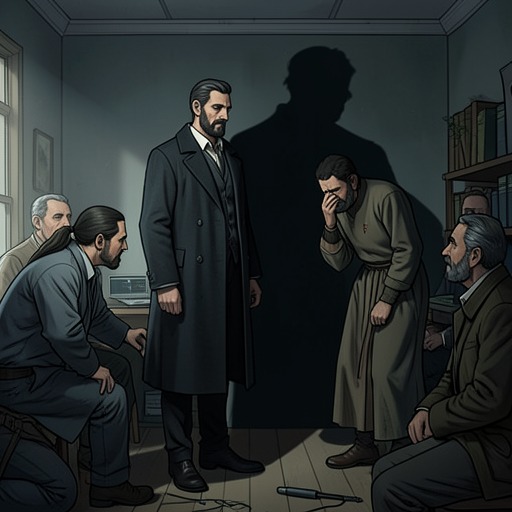
Jonathan’s Chart Theft Confrontation
Chasing SunlightJonathan’s Chart Theft Confrontation is a decisive recovery and confrontation in which Jonathan Heights retrieves his encoded maps from Harrington, an agent connected to the Society of Explorers, and threatens the organization with destruction if it continues obstructing his expedition. The event converts the maps from vulnerable possessions into instruments of defiance and confirms that Jonathan’s pursuit of sunlight will proceed against both the dangers of the eastern world and the authorities that claim to regulate exploration.
The Stolen Maps and the Pursuit of Sunlight
The confrontation takes place in a merchant boardinghouse in Autochthon Reach, whose floors are organized around studies and offices for people whose lives depend on the exchange of coin. Jonathan Heights and Eleanor McAvey reach the third-floor study after moving through a locked-looking basement and climbing a stone stairway. The setting is important because it places the theft within an ordinary commercial environment, while the maps themselves carry consequences far beyond ordinary commerce: although encoded, their symbols retain enough significance to inspire dread, and the heavy paper curls into cylinders as Harrington grips it.
Jonathan identifies the man in the room as Mister Harrington, a bespectacled, pencil-necked figure who resembles the people who previously harassed him in Beacon. Jonathan sees him as one of the descendants and associates of genuine explorers who presume to understand the truth without personally confronting the world beyond the settled cities. Harrington’s presence therefore represents more than a single thief. He stands for an establishment that possesses or claims authority over exploratory knowledge while attempting to prevent Jonathan from extending that knowledge eastward.
The immediate stakes are practical as well as ideological. Jonathan has been preparing the Endeavor for a long expedition, arranging financing, equipment, supplies, and transport. Earlier, he had offered Captain Montgomery blank golden plates as a means of outfitting the ship and had planned to send supplies by train to Danby’s Point before the Endeavor’s final loading. The maps are consequently part of a larger logistical system: without them, the expedition’s route and purpose are compromised; with them, Jonathan can continue toward the unknown edge of the map.
Recovery in the Boardinghouse Study
When Jonathan bursts into the study, Harrington spills ink across the table and then seizes the maps. Jonathan demands an explanation for the possession of what belongs to him, while Harrington attempts to retain control through the documents’ apparent legitimacy and importance. The exchange quickly becomes physical and supernatural rather than remaining a dispute over property.
Eleanor McAvey recovers the maps with startling ease. After asking Jonathan to confirm that they are his, she takes the rolled papers from Harrington and offers them back to Jonathan, who receives them gravely. Harrington is left staring at his empty hands, unable to understand how she removed the documents. The recovery reverses the immediate power arrangement: the thief has the papers, then suddenly has nothing, while Jonathan once again possesses the knowledge required for the expedition.
Eleanor then draws a long dagger and appears ready to deal with Harrington directly. Jonathan stops her with his cane. His intervention does not indicate mercy toward Harrington; instead, it shows that Jonathan wants the confrontation to yield information and a message as well as punishment. He asks who Harrington represents and why, then identifies the Society of Explorers as the likely authority behind the theft. The maps are thus recovered before the institutional motive is fully exposed, allowing Jonathan to turn the scene from a private act of violence into a political warning.
The Threat to the Society of Explorers
Harrington confirms that Jonathan knows who he is and complains that Jonathan ignored the Society’s warnings. Jonathan answers with a declaration that nobody will stop him from finding sunlight. The statement condenses his expedition’s central objective into an absolute commitment: sunlight is not a curiosity or a negotiable destination, but the goal against which every rival claim must be measured.
Jonathan then orders Harrington to carry a message back to Beacon. He dismisses the Society of Explorers as frightened, petty, and irrelevant, condemning its members for recoiling from the darkness and asserting that he understands how little humanity matters to the forces beyond the known world. He threatens to destroy any Society agent who crosses his path, regardless of rank or role, and states that he will not tolerate anyone blocking his route to sunlight.
The threat has an immediate bodily effect. As Jonathan advances, Harrington is forced almost into the fire; his clothes begin to smolder, his eyes become glassy with panic, and he cannot look away or blink because of the force of Jonathan’s displeasure. Jonathan stops only when he reaches the table, then turns away in disgust. The scene shifts the value of power from Harrington’s possession of the maps to Jonathan’s mastery of the room. Harrington entered as the apparent guardian of forbidden knowledge; he leaves as a terrified courier compelled to transmit Jonathan’s ultimatum.
Securing the Charts and Continuing the Expedition
Jonathan and Eleanor leave the boardinghouse without further resistance, passing the local toughs who lack the wit to fear the person departing. Eleanor remarks that Jonathan can be frightening when angry, while Jonathan gives the concise justification that Harrington should not have stolen from him. Their exchange establishes a contrast between Eleanor’s amused recognition of Jonathan’s menace and Jonathan’s own practical interpretation of the event: to him, the violence is a consequence of trespass against an essential possession.
Back aboard the Endeavor, Jonathan places the maps in a more discreet location in his cabin. He recognizes that the ship’s safe is not absolute protection and that anyone sufficiently determined can defeat an obvious lock. The maps will eventually be brought out and used, but once the expedition is underway there will be no dock or port where a thief or saboteur can easily enter. Their security therefore depends partly on movement: the charts become safer when the Endeavor leaves the settled spaces in which institutions and agents can reach them.
Captain Montgomery offers the ship’s safe or his own quarters, but Jonathan declines. He explains that this is not because he distrusts Montgomery; the responsibility is simply not yet one he is ready to transfer. Jonathan trusts his own ability to repel both ordinary intruders and opponents with more esoteric talents than Montgomery’s crew. He also gives Antomine an edited account of the incident when the inquisitor returns, allowing Antomine to decide how to handle any official complaints without surrendering the full circumstances of the confrontation.
The recovery directly supports the expedition’s preparation. Jonathan inspects the cargo to ensure that it has not been tampered with, finding equipment ranging from a portable luminiferous terrestrite distillation apparatus and lifting-gas separator to water filters, searchlights, crew-served zint guns, food, clothing, bedding, and spare parts. Some containers, especially those holding fire dust and unflame, show signs of opening and minor pilfering, but Jonathan chooses not to trigger an investigation that might delay departure. Recovering the maps is therefore part of a wider struggle against obstruction: he treats every delay, theft, and administrative complication as another force attempting to keep him from the east.
Consequences and Narrative Significance
The confrontation marks a value shift from threatened expedition to renewed agency. Before Eleanor recovers the charts, Harrington possesses the documents and the Society’s warnings appear capable of constraining Jonathan’s movement. After the recovery, Harrington is reduced to a messenger, the Society is openly named as an enemy, and Jonathan retains both the maps and control of the expedition’s next stage. The scene’s conflict is not resolved by reconciliation or legal judgment; it is resolved through possession, intimidation, and the promise of future retaliation.
The maps also reveal the material politics of exploration. They are encrypted, physically unstable, and dangerous even in symbolic form, yet they are treated as tradable or stealable objects within a boardinghouse economy. Jonathan’s expedition depends on converting knowledge into logistics: golden plates help finance the refit, raw metal later serves as barter among the Caravaneers, and cargo must be assembled before the Endeavor can travel beyond familiar ports. The Society’s attempt to control the charts is therefore an attempt to control access to the route, the resources discovered along it, and the authority to define what counts as legitimate exploration.
Jonathan’s later conduct shows that retrieving the charts does not make the journey safe. When the crew disturbs an unknown creature or phenomenon, he immediately judges it beyond their ability to fight and leads the retreat through furnace heat and the chaos of awakened beasts. In Terminus, by contrast, the enforced peace and friendliness frustrate him because he cannot uncover the threatening secret he expects to find. At the Crimson Caldera, he accepts that Airman Stutt’s affliction may require the Endeavor to run its engines at full power, risking the depletion of the ship’s zint reserves. Before Bright Defile, even the destination itself remains something Captain Montgomery says he will believe only when he sees it. These later dangers give the chart theft its proper scale: recovering the maps restores direction, but direction is not mastery.
The expedition ultimately returns with the Endeavor battered and carrying an immense quantity of gold, drawing more public interest than the lone inquisitor or the three women who disembark. That aftermath retrospectively confirms the importance of what the Society tried to suppress. The maps enabled a voyage that produced wealth, knowledge, and consequences far beyond a dispute in a third-floor study, while Jonathan’s threat established the personal and institutional conflict that shadows his progress toward sunlight.